Close your eyes.
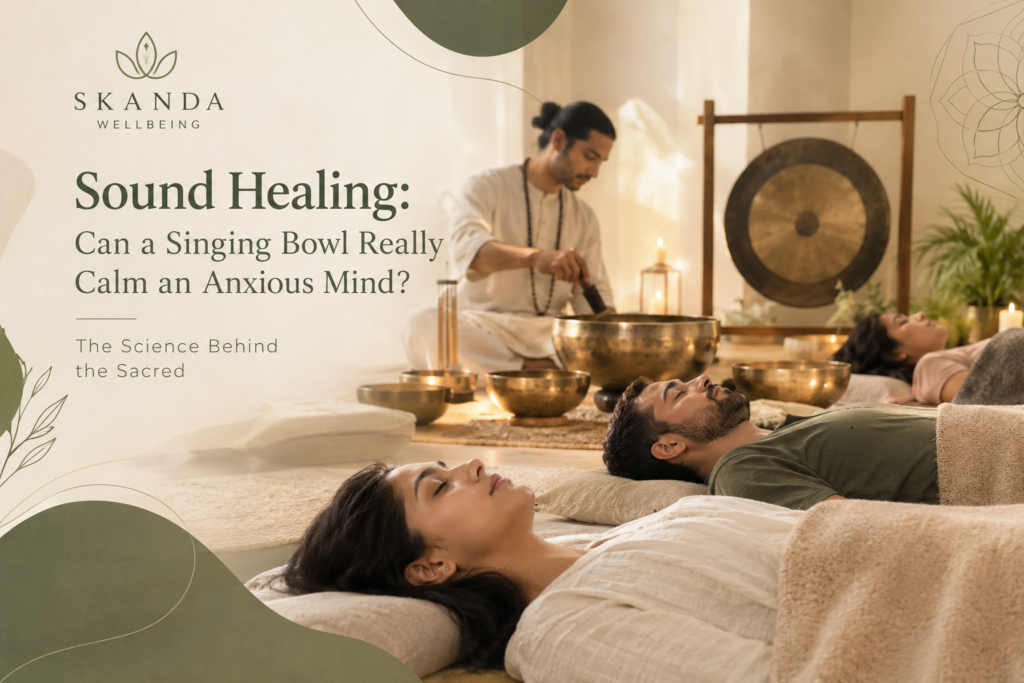
A singing bowl sounds.
The vibration seems to move through the room.
Your breathing slows.
Your shoulders drop.
For a moment, the mind that was racing all morning becomes quieter.
But then comes the obvious question:
Is something actually happening—or does it simply feel relaxing?
This is where sound healing becomes fascinating.
Because beneath the spiritual language of frequency and vibration lies a growing scientific interest in how sound-based practices may influence relaxation, mood, stress and physiological responses.
At Skanda Wellbeing, Sound Healing uses singing bowls, gongs, chimes and voice within an immersive therapeutic experience designed to encourage relaxation and meditation.
So let’s separate the mystery from the marketing.
Why Does Sound Affect Us So Strongly?
Sound is not just something we hear.
It is physical vibration travelling through a medium.
And humans are remarkably responsive to rhythm, pitch, volume and repetition.
Think about the effect of music.
One song can make you nostalgic.
Another can energise you.
A lullaby can make a child sleepy.
A sudden loud sound can make your body react instantly.
Sound interacts with attention, emotion and perception.
So it isn’t surprising that carefully structured sound can become part of relaxation and meditation practices.
Explore more Blogs like Can Sound Healing Really Change Your Brain?
What Happens During a Singing Bowl Session?
A singing bowl can be struck or played around its rim, creating a sustained tone and audible resonance.
Depending on the instrument, environment and technique, you may notice both sound and vibration.
At Skanda, a Sound Healing session can involve singing bowls, gongs, chimes and voice, with the experience designed around relaxation and meditative states.
People may describe the experience as:
- Deep relaxation
- Reduced mental chatter
- Emotional spaciousness
- Greater body awareness
- Easier meditation
- A feeling of stillness
Individual responses vary.
And that’s important.
What Does the Research Say?
The research is promising—but it isn’t a blank cheque.
A 2025 systematic review examined 19 clinical studies involving singing bowls across several populations and outcomes.
The review found potential benefits involving anxiety, depression, sleep and some physiological measures. It also highlighted significant differences between studies, meaning stronger research is still needed before making broad clinical claims.
Another 2025 systematic review focused specifically on Tibetan Singing Bowl interventions in adults and found potential effects on anxiety, depressive symptoms, autonomic measures and brain activity, while also emphasising limitations such as small samples, heterogeneous study designs and limited follow-up.
In other words:
There is something worth investigating.
But science hasn’t established that singing bowls are a cure for anxiety or disease.
That distinction is essential.
What About the “Parasympathetic Response”?
You may hear sound healing described as something that activates the parasympathetic nervous system.
The parasympathetic branch is associated with rest-and-digest functions.
Relaxation practices can influence physiological arousal, breathing and heart-rate patterns.
But we should be cautious about turning every relaxing experience into a claim about a specific biological mechanism.
The simplest explanation may sometimes be the best one:
A calm environment + sustained sound + focused attention + slower breathing can create conditions that support relaxation.
And relaxation itself can be valuable.
Sound Healing Isn’t Just About the Bowl
The bowl is only one part of the experience.
Consider the entire environment:
The lights.
The posture.
The quiet.
The practitioner’s guidance.
The absence of notifications.
The invitation to stop doing.
The rhythm of the sound.
The attention moving away from external demands.
All of these factors can influence the experience.
This is why reducing sound healing to “a bowl that vibrates at a certain frequency and fixes the body” misses the bigger picture.
The experience is multidimensional.
Why Some People Find Sound Easier Than Meditation
Meditation can feel frustrating when you’re beginning.
Sit still.
Close your eyes.
Observe your thoughts.
And suddenly your brain remembers every unfinished task you’ve ever had.
Sound can provide an anchor.
Instead of trying to create silence, you have something to listen to.
Instead of fighting thoughts, you can gently return attention to the sound.
This can make meditation feel more accessible.
Skanda’s own approach combines sound healing with meditation practices, creating an entry point for people who may find traditional silent meditation challenging.
Can Sound Healing Release Emotions?
People sometimes experience tears, memories, sensations or unexpected emotions during deeply relaxing practices.
That doesn’t necessarily mean a particular sound has “released trauma from a specific body part.”
A more grounded way to understand it is that relaxation can create psychological space.
When you’re constantly busy, there may be little room to notice what you’re feeling.
When you finally become still, emotions may become more noticeable.
That can feel like release.
And it can be meaningful.
But emotional processing should always be approached gently, especially for people with significant trauma or psychological distress.
Sound Healing and Nervous System Regulation
This is where the two September themes connect.
Our previous article explored nervous-system regulation and why the conversation has become so prominent.
Sound healing can be viewed as one complementary practice that may support relaxation and mindful awareness.
The current evidence around singing bowls is encouraging but still developing.
So rather than asking:
“Does sound healing cure anxiety?”
A better question is:
“Can sound-based relaxation become one useful part of my wellbeing practice?”
For many people, the answer may be yes.
Who Might Enjoy Sound Healing?
You may particularly enjoy exploring it if:
- You struggle to sit quietly
- Your mind feels constantly busy
- You want a gentle relaxation practice
- You enjoy meditation but want more sensory grounding
- You are curious about vibrational practices
- You want time away from digital stimulation
- You are exploring holistic approaches to wellbeing
It doesn’t require previous meditation experience.
Skanda’s service information states that no prior experience is required for its wellbeing practices.
What a Session Is Really Giving You
Perhaps the most valuable part isn’t the sound itself.
It is permission.
Permission to stop.
Permission to breathe.
Permission to listen.
Permission to notice your body.
Permission to be still without needing to achieve anything.
In a world that constantly asks:
“What’s next?”
sound healing creates a small pocket of:
“Be here.”
Sacred Doesn’t Have to Mean Unscientific
There is no need to choose between spirituality and curiosity.
You can honour the sacred quality of a singing bowl while remaining honest about what science does—and does not—know.
You can enjoy the ritual without making exaggerated medical claims.
You can explore vibration without believing every claim about frequency.
You can be open-minded without switching off your critical thinking.
That balance is powerful.
The Sound Ends. The Practice Continues.
Eventually, the bowl becomes silent.
And that silence can be the most interesting part.
What happens inside you when the sound disappears?
Do you feel calmer?
More present?
More aware of your body?
More connected to your breath?
Perhaps that is the real invitation of sound healing.
Not to escape yourself.
But to return to yourself.
At Skanda Wellbeing, Sound Healing is offered as part of a wider integrative approach to relaxation, meditation and emotional wellbeing.
If you’re curious about what a sound healing experience feels like for you, don’t begin with belief.
Begin with experience.
Listen.
Breathe.
Notice.
Book a Sound Healing session with Skanda Wellbeing.