What if your company’s wellness programme is helping employees move more—but not necessarily helping them feel better?
For years, corporate wellness had a fairly predictable formula.
Gym memberships.
Health screenings.
Step challenges.
Fitness competitions.
Nutrition talks.
Yoga sessions.
All valuable.
But today’s workplace is asking a different question:
What happens when the body is at work, but the mind is exhausted?
An employee can be physically active and still feel emotionally drained.
A team can hit its targets and still experience chronic stress.
A workplace can offer a gym and still struggle with burnout, disengagement, poor boundaries and low psychological safety.
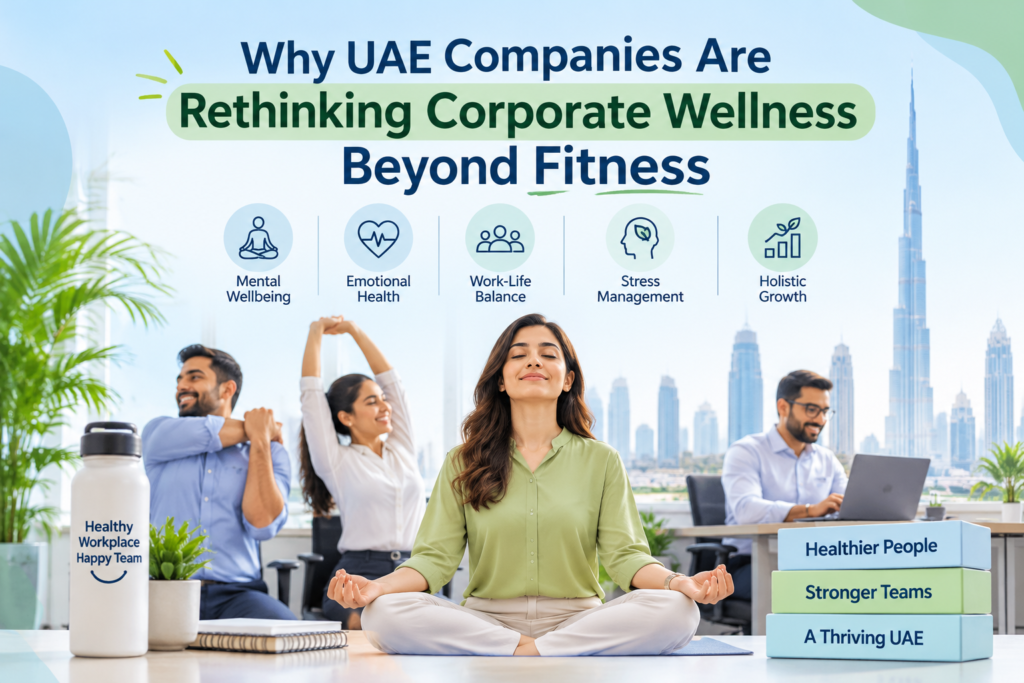
This is why corporate wellness in the UAE is entering a new phase.
The conversation is shifting from:
“How do we keep employees physically healthy?”
to:
“How do we support the whole person at work?”
And that shift creates a significant opportunity for UAE organisations, HR leaders and people-and-culture teams.
The UAE Corporate Wellness Market Is Growing
The numbers tell an interesting story.
IMARC estimates that the UAE corporate wellness market grew from approximately US$360.88 million in 2025 to US$381.18 million in 2026, with a projection of approximately US$590.58 million by 2034. Another market-research provider, Grand View Research, estimates the 2025 UAE market at US$255.8 million and projects US$353.6 million by 2033.
The estimates differ because research firms use different market definitions, datasets and methodologies.
But the direction is consistent:
Corporate wellness is becoming a significant business category in the UAE.
The wider picture is even bigger.
The Global Wellness Institute’s 2025 UAE report valued the country’s overall wellness economy at US$40.8 billion in 2024, following 14.3% growth between 2019 and 2024. It also identified workplace wellness as one of the UAE’s fastest-growing wellness sectors.
And this isn’t just a future trend.
A Bupa Global survey reported that 88% of UAE organisations planned to increase their investment in employee wellbeing in 2025, while 94% of senior leaders surveyed said wellbeing programmes enhance productivity.
The question is no longer whether companies are investing in wellness.
The more interesting question is:
What are they investing in—and is it addressing the real needs of their workforce?
You will be also like to read 9 Nights, 9 Chakras
Why Fitness Still Dominates Corporate Wellness
Walk into a corporate wellness conversation and fitness is often the easiest place to start.
It is visible.
It is measurable.
It is familiar.
And employees generally understand what a fitness initiative means.
A company can organise:
- a fitness challenge
- a yoga session
- a walking competition
- a health screening
- a gym subsidy
- a nutrition workshop
- a sports day
These initiatives can be useful components of an employee wellbeing programme.
Market research also continues to show strong demand for physical wellness.
One 2026 market analysis estimates fitness represented 34.88% of UAE corporate wellness revenue in 2025, while identifying stress management as a faster-growing service segment.
That distinction matters.
Fitness is visible.
Emotional wellbeing is often invisible.
And invisible doesn’t mean unimportant.
The Emotional Wellbeing Gap
Imagine two employees.
Employee A has access to a gym, joins the company’s step challenge and receives an annual health screening.
Employee B has the same benefits—but is struggling with:
- chronic workplace stress
- emotional exhaustion
- difficult boundaries
- isolation
- poor sleep
- pressure to constantly perform
- difficulty switching off
- lack of connection with colleagues
The organisation may technically have a wellness programme.
But does it have a wellbeing culture?
That’s a different question.
A 2025 MetLife UAE employee-benefits report found that only 28% of employees were offered stress-management programmes, while more than 70% lacked access to such programmes. The report also found that work-life balance and stress management were among the non-medical wellbeing benefits being offered by employers.
This creates an important opportunity.
The next generation of employee wellbeing programmes in the UAE cannot be built exclusively around physical fitness.
They need to consider the emotional experience of work too.
What Is Corporate Wellness, Really?
So, what is corporate wellness?
At its broadest, corporate wellness refers to organisational initiatives designed to support employee health and wellbeing.
That can include:
Physical wellbeing
Fitness, movement, nutrition, ergonomics and preventive health.
Mental wellbeing
Stress management, mindfulness, mental-health education and access to support.
Emotional wellbeing
Emotional awareness, resilience, boundaries, self-regulation and healthy workplace relationships.
Social wellbeing
Connection, belonging, collaboration and community.
Financial wellbeing
Financial education, planning and support.
Workplace wellbeing
Culture, psychological safety, workload, flexibility and employee experience.
Spiritual or purpose-oriented wellbeing
Meaning, values, reflection and a sense of purpose—where appropriate to the organisation and its workforce.
This is where the corporate wellness conversation becomes more sophisticated.
Wellness isn’t one activity.
It’s an ecosystem.
Why Emotional Wellness at Work Matters
There is a difference between being productive and being well while productive.
A person can continue meeting deadlines while feeling depleted.
They can attend every meeting while mentally checking out.
They can appear engaged while privately struggling.
They can say:
“I’m fine.”
because that’s what workplace culture has taught them to say.
This is why emotional wellness at work deserves a place in corporate wellbeing strategy.
Employees may need practical tools to:
- recognise stress signals
- create healthier boundaries
- manage emotional reactions
- practise mindfulness
- communicate more effectively
- build self-awareness
- reconnect with purpose
- develop healthier responses to pressure
- create sustainable habits
These are not simply “soft” issues.
They influence how people communicate, collaborate and experience the workplace.
Current LinkedIn conversations around UAE corporate wellness increasingly reflect this shift. Posts from wellness providers and HR-focused professionals are moving beyond gym-based programmes toward stress management, employee engagement, workplace culture, mental wellbeing, connection and holistic wellness.
The Energy Gap: What Happens When Employees Never Truly Reset?
There is another layer entering the corporate wellness conversation:
energy.
Not energy in the sense of a measurable medical treatment.
Rather, the everyday experience of feeling mentally and emotionally depleted.
Think about how employees describe a difficult week:
“I’m drained.”
“I have no energy left.”
“I can’t switch off.”
“My head is constantly running.”
“I need to reset.”
These are signals that a wellness programme focused only on physical activity may not address the complete employee experience.
This is where holistic approaches such as:
- guided mindfulness
- meditation
- breath awareness
- sound-based relaxation
- emotional wellbeing workshops
- energy-awareness practices
- reflective exercises
- conscious connection activities
can complement more traditional corporate wellness initiatives.
The purpose isn’t to replace medical or psychological support.
It is to create additional opportunities for employees to pause, reflect and develop healthier wellbeing habits.
What Corporate Wellness Programmes Work Best?
There isn’t one universal programme that works for every organisation.
A multinational technology company, a hospital, a school, a financial institution and a start-up may have completely different workforce needs.
The better question is:
What does your workforce actually need?
A strong corporate wellness programme in the UAE should ideally consider:
1. Employee needs
What are employees experiencing?
Stress?
Disconnection?
Sedentary work?
Communication challenges?
Burnout risk?
2. Organisational culture
What does the workplace already value?
Performance?
Connection?
Innovation?
Leadership?
Work-life balance?
3. Accessibility
Can employees actually participate?
Are activities inclusive across ages, cultures, abilities and job roles?
4. Relevance
Does the programme solve a real workplace problem—or simply look good on the annual HR calendar?
5. Consistency
One wellness day can create awareness.
A sustained approach can create habits.
6. Measurement
Organisations should consider meaningful indicators such as participation, employee feedback, engagement and behavioural outcomes rather than simply counting how many sessions were delivered.
Beyond the Annual Wellness Day
Here’s a common workplace scenario.
The company organises one wellness day.
There is yoga at 10 a.m.
A health check at noon.
Healthy snacks in the cafeteria.
A motivational speaker.
Photos go on LinkedIn.
Everyone returns to work.
Then Monday arrives.
The deadlines remain.
The workload remains.
The communication issues remain.
The stress remains.
The problem isn’t that the wellness day was pointless.
The problem is expecting one event to carry the weight of an entire wellbeing strategy.
Wellness becomes more meaningful when the experience connects to everyday work.
That could mean:
- monthly wellbeing workshops
- manager education
- mindfulness sessions
- emotional intelligence programmes
- stress-management sessions
- team connection activities
- leadership wellbeing
- resilience workshops
- individual support pathways
- ongoing employee engagement
The goal is not more events.
The goal is better integration.
What Does a Skanda Wellbeing Corporate Workshop Look Like?
This is where corporate wellbeing can move from theory to experience.
A Skanda Wellbeing corporate workshop can be customised around the organisation’s needs rather than delivered as a one-size-fits-all session.
The current Skanda corporate workshop positioning includes areas such as:
- Emotional Healing
- Stress Management & Mindfulness
- Energy Alignment
- Team Connection
- Leadership Awareness
- Mental Clarity
- Workplace Wellbeing
Skanda’s current corporate messaging describes its workshops as spaces where stress can be explored through practices designed to support clarity, balance, connection and purposeful growth.
A workshop may therefore begin with a simple question:
“What is your team experiencing right now?”
From there, the experience can be designed around the organisation.
A Sample Skanda Corporate Wellbeing Experience
Opening: Check In
Participants are invited to pause and become aware of how they are arriving in the room.
Not performance.
Not productivity.
Awareness.
Module 1: Understanding Workplace Stress
Employees explore what stress looks like in everyday professional life and how it can influence attention, communication and behaviour.
Module 2: Mindfulness & Grounding
Simple practices can help employees create moments of intentional pause during demanding workdays.
Module 3: Emotional Awareness
Participants explore emotional triggers, boundaries and healthier ways of responding to workplace pressure.
Module 4: Energy & Reset
Depending on the organisation and workshop format, holistic practices such as sound healing, guided relaxation or energy-awareness exercises can be incorporated.
Module 5: Team Connection
The workshop can include reflective exercises designed to encourage communication, empathy and human connection.
Closing: From Insight to Action
The final question becomes:
“What is one change you can take back into your working day?”
Because the best workshop isn’t the one people remember for an hour.
It’s the one that changes what they do on Monday morning.
Why Holistic Corporate Wellness Is Becoming More Relevant in the UAE
The UAE workforce is diverse, international and fast-moving.
That makes wellbeing more complex.
Different employees may have different:
- cultural backgrounds
- communication styles
- family structures
- stressors
- work expectations
- wellness preferences
- attitudes toward mental health
A generic wellness programme may therefore have limited relevance.
Current UAE workplace discussions increasingly emphasise inclusive, employee-centred and measurable wellbeing rather than simply adding isolated activities to the calendar. This is particularly visible in current conversations around structured workforce wellbeing in Abu Dhabi’s healthcare sector.
The future of corporate wellness is therefore less about:
“What activity should HR organise next?”
and more about:
“What kind of workplace are we intentionally creating?”
Meet Dr. Seema Nambiar
A corporate wellbeing programme is ultimately shaped by the person facilitating it.
Dr. Seema Nambiar, Founder & Director of Skanda Wellbeing, brings a multidisciplinary approach to wellbeing, combining modern therapeutic approaches with holistic and ancient wisdom traditions.
Her professional background includes work across:
- emotional wellbeing
- hypnotherapy
- Past Life Regression
- Life Between Lives work
- Sound Healing Therapy
- Mantra Nada Yoga
- mindfulness
- holistic wellbeing
Skanda’s published profile describes Dr. Seema as an educationist, emotional wellbeing coach and hypnotherapist, with credentials including NGH-certified Master Hypnotist, alongside training and practice in Past Life Regression and Sound Healing Therapy.
Her LinkedIn profile identifies her with Skanda Wellbeing in Dubai, while Skanda’s current corporate content specifically positions her as the facilitator behind customised organisational wellness workshops.
This combination allows Skanda to approach corporate wellbeing through more than one lens:
mind + body + emotions + awareness + connection.
Corporate Wellness Doesn’t Have to Mean “One More HR Initiative”
Here’s the shift organisations need to consider.
Employees don’t necessarily need another event.
They need experiences that feel relevant to their lives.
A successful employee wellbeing programme in the UAE could mean giving people practical tools to:
Pause.
Regulate.
Reflect.
Reconnect.
Communicate.
Recover.
Return with greater awareness.
That is a very different proposition from simply putting “Wellness Day” on the calendar.
The ROI Conversation Is Changing
For HR leaders, wellness cannot exist entirely outside business priorities.
Organisations naturally want to understand:
Does it improve engagement?
Will employees actually participate?
Does it support retention?
Can it reduce avoidable stress?
Does it strengthen workplace culture?
Can employees apply what they learn?
Bupa’s UAE survey found that senior leaders were increasingly linking wellbeing investment with productivity, while current market research identifies productivity, retention and competitiveness among the drivers of corporate wellness investment.
But ROI should not be reduced to one number.
There is also a less visible return:
How employees experience the organisation.
Because culture isn’t only what leadership says.
Culture is what employees experience repeatedly.
The Future of Corporate Wellness in the UAE
The UAE’s wellness economy is expanding.
Corporate wellness investment is growing.
Mental and emotional wellbeing are becoming more visible in workplace conversations.
And employers are increasingly exploring ways to make wellbeing part of the employee experience rather than an isolated benefit.
The next evolution may therefore look less like:
Fitness vs mental health
and more like:
Fitness + emotional wellbeing + mental wellbeing + connection + purpose + sustainable workplace practices.
The future isn’t about abandoning fitness.
It’s about expanding the definition of wellness.
Is Your Company’s Wellness Strategy Ready for the Next Step?
Ask your HR or leadership team:
Are we supporting physical health—but overlooking emotional wellbeing?
Do our employees have practical tools for managing workplace stress?
Are our wellness initiatives inclusive?
Do employees actually participate?
Are we measuring meaningful outcomes?
Does our wellness strategy reflect the reality of how our people work?
If the answer to some of these questions is “not yet,” that doesn’t mean your organisation has failed.
It means there is room to evolve.
Bring Meaningful Wellbeing Into Your Workplace
At Skanda Wellbeing, corporate wellbeing is approached as more than a fitness activity or one-day event.
Workshops can be customised around your organisation’s people, culture and wellbeing priorities, incorporating areas such as stress management, mindfulness, emotional wellbeing, mental clarity, energy awareness, team connection and leadership awareness.
Whether you’re an HR leader planning an employee wellbeing programme, a People & Culture team building your annual wellness calendar, or a leadership team looking for a more holistic approach to workplace wellbeing, the first step is a conversation.
Ready to rethink corporate wellness?
Enquire about a customised corporate wellbeing workshop with Skanda Wellbeing.
Let’s move beyond:
“What wellness activity can we organise?”
and start asking:
“What does our workforce genuinely need?”
Because a healthier workplace isn’t built by adding more things to the calendar.
It’s built by creating a culture where people can perform, connect, recover and thrive.
Enquire about a Corporate Wellbeing Workshop with Skanda Wellbeing.