A Gentle Guide to Navratri as Inner Alignment
What if Navratri wasn’t only a festival you celebrated outside—but also a journey you could experience within?
Nine nights.
Nine forms of Devi.
Nine invitations to pause, reflect and reconnect.
And perhaps, nine opportunities to ask yourself:
What do I need to strengthen?
What do I need to release?
What am I ready to become?
Navratri is traditionally a time of devotion, worship and celebration of Shakti—the divine feminine power represented through different forms of Goddess Durga. The Government of India’s tourism platform describes the nine nights as a spiritual journey associated with the nine forms of Durga, while also highlighting introspection, prayer, meditation and renewal.
But there is another way to engage with the season.
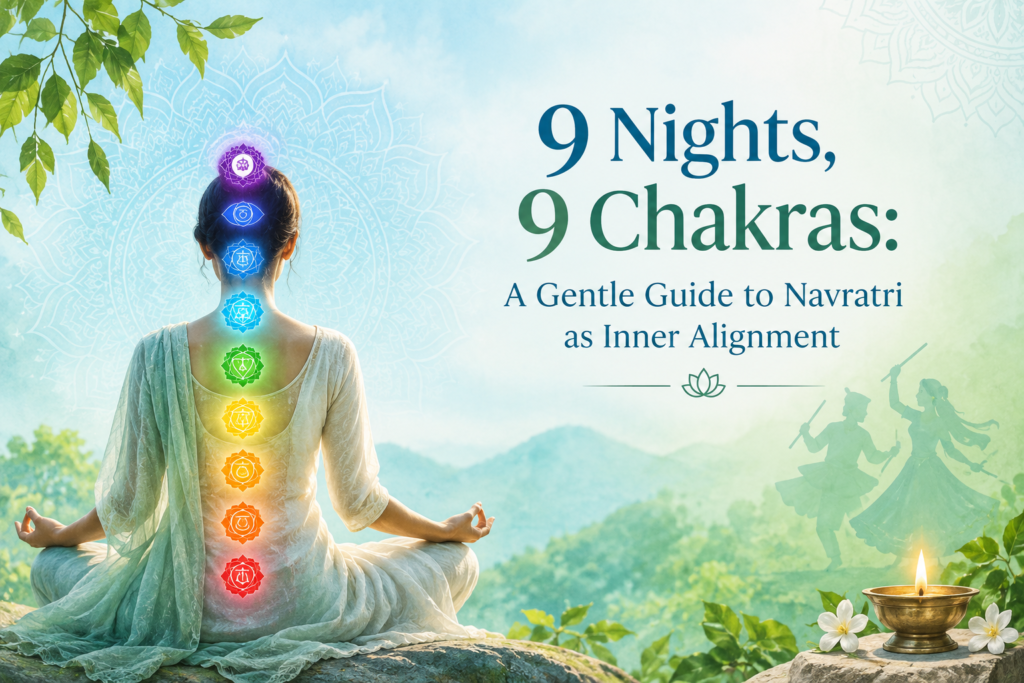
At Skanda Wellbeing, we invite you to explore Navratri as an inner alignment journey—using the familiar seven-chakra framework as a reflective map, and adding two final stages for reflection and release.
This is not a claim that traditional Navratri scripture assigns one chakra to each night.
It is a contemporary wellness interpretation inspired by two different spiritual frameworks.
Think of it as:
Nine nights. Nine reflections. One journey inward.
What Does Navratri Traditionally Represent?
The word Navratri comes from Nav meaning nine and Ratri meaning nights.
During Sharad Navratri, devotees honour different forms of Goddess Durga, collectively known as Navadurga.
The nine forms are traditionally identified as:
- Maa Shailputri
- Maa Brahmacharini
- Maa Chandraghanta
- Maa Kushmanda
- Maa Skandamata
- Maa Katyayani
- Maa Kalaratri
- Maa Mahagauri
- Maa Siddhidatri
Each form carries its own symbolism and devotional significance.
Different regions of India observe Navratri differently.
There is fasting.
There is prayer.
There is Durga Puja.
There is Garba and Dandiya.
There are Golu displays.
There are rituals, music, food, community and devotion.
So there isn’t one single way to experience Navratri.
And that diversity is part of its beauty.
The Ministry of Tourism describes Navratri as a festival that celebrates the divine feminine in many regional forms, while Maharashtra Tourism highlights the nine manifestations of Goddess Durga and their associated symbolism.
But What If You Made Navratri Personal?
Between work.
Family.
Notifications.
Meetings.
Responsibilities.
Social commitments.
Life can become very outward-facing.
Navratri offers a natural pause.
A chance to turn inward.
Rather than asking only:
“What am I celebrating?”
you could also ask:
“What am I cultivating within myself?”
This is where the idea of a Navratri healing series can become meaningful.
Not as a replacement for traditional worship.
Not as a claim about what Navratri historically means.
But as a personal reflection practice inspired by the season.
Why Chakras?
The word chakra is commonly translated as “wheel” or “circle,” and chakras are described within Indian spiritual and yogic traditions as subtle centres associated with different aspects of human experience.
The commonly referenced seven-chakra model includes:
Root — Muladhara
Sacral — Svadhisthana
Solar Plexus — Manipura
Heart — Anahata
Throat — Vishuddha
Third Eye — Ajna
Crown — Sahasrara
Modern wellness practices often use these as a symbolic framework for reflection around themes such as grounding, creativity, confidence, compassion, communication, intuition and spiritual connection.
For this Navratri chakra alignment guide, we take those seven centres and add two further stages:
Reflection
and
Release.
That gives us nine nights.
Nine inner invitations.
9 Nights. 9 Inner Themes.
Night 1 — Root Chakra: Ground
Theme: Safety, stability and belonging
The first night begins at the foundation.
Before you grow, you need somewhere to stand.
The Root Chakra is traditionally associated with grounding, stability and a sense of connection.
Tonight, ask yourself:
Where in my life do I feel grounded?
And:
Where am I constantly operating from uncertainty?
Simple practice
Sit quietly for five minutes.
Place your feet firmly on the floor.
Take slow, comfortable breaths.
Notice the physical support beneath you.
Then write:
“What helps me feel safe, stable and supported?”
You don’t need to solve anything.
Just notice.
Night 2 — Sacral Chakra: Feel
Theme: Emotion, creativity and flow
The second reflection moves toward emotional awareness.
How often do you actually allow yourself to feel?
Not analyse.
Not suppress.
Not explain.
Just feel.
Tonight, ask:
What emotion have I been avoiding?
And:
Where could I allow more creativity and joy into my life?
Simple practice
Play a piece of music that makes you feel something.
Close your eyes.
Allow the emotion to be present without judging it.
Then journal:
“What am I feeling—and what might this feeling be asking me to notice?”
Night 3 — Solar Plexus Chakra: Empower
Theme: Confidence, choice and personal power
The third night is about agency.
Not control over other people.
Control over your own choices.
Your boundaries.
Your decisions.
Your direction.
Ask yourself:
Where am I giving away my power?
And:
Where do I need to make a more intentional choice?
Simple practice
Write down one decision you have been postponing.
Then complete this sentence:
“If I trusted myself a little more, I would…”
Don’t force an answer.
Let it emerge.
Night 4 — Heart Chakra: Connect
Theme: Compassion, connection and openness
The heart invites a different kind of strength.
The strength to soften.
The strength to forgive.
The strength to receive.
The strength to care without losing yourself.
Ask:
Where am I holding onto resentment?
Where do I need more compassion—for myself or someone else?
Simple practice
Place your hand gently over your heart.
Take five slow breaths.
Think of one person you appreciate.
You don’t have to message them.
Simply acknowledge what they have brought into your life.
Then write:
“Today, I choose to make more room for…”
Night 5 — Throat Chakra: Express
Theme: Truth, communication and authentic expression
How much of yourself do you edit before speaking?
At work.
At home.
In relationships.
On social media.
Sometimes we don’t lack a voice.
We lack permission to use it.
Tonight, reflect on:
What am I not saying?
And:
What truth needs to be expressed with kindness?
Simple practice
Write a sentence you have been afraid to say.
Don’t send it.
Just write it.
Then ask:
“Can I express this honestly without abandoning compassion?”
That is the beginning of conscious communication.
Night 6 — Third Eye Chakra: See
Theme: Perspective, awareness and intuition
The sixth night asks you to step back from the noise.
Sometimes clarity doesn’t come from collecting more information.
It comes from creating enough space to see what is already there.
Ask:
What am I refusing to see?
What pattern keeps repeating?
What perspective might I be missing?
Simple practice
Take ten minutes without your phone.
Sit somewhere quiet.
Watch your thoughts without following every one.
Then write three observations about your life that you might have overlooked this week.
No judgement.
Just awareness.
Night 7 — Crown Chakra: Connect
Theme: Meaning, spirituality and something larger than yourself
The Crown Chakra is traditionally associated within chakra systems with higher consciousness and spiritual connection.
This doesn’t require a particular belief system.
It can simply mean asking:
What gives my life meaning?
What do I want to contribute?
What makes me feel connected to something larger than my immediate responsibilities?
Simple practice
Spend five minutes in silence.
No music.
No phone.
No guided meditation.
Just silence.
Ask yourself:
“What matters to me beyond achievement?”
Then listen.
Night 8 —-Reflection: What Have I Been Carrying?
Here we intentionally step outside the seven-chakra model.
Because alignment isn’t only about adding more.
Sometimes it is about noticing what you are carrying.
Old expectations.
Old identities.
Old fears.
Old narratives.
Old definitions of success.
Ask:
What no longer belongs in the next version of my life?
Simple practice
Write three things you are ready to stop carrying.
They could be:
- an outdated belief
- an unhealthy habit
- an expectation
- a relationship pattern
- an internal criticism
- the need to please everyone
You don’t have to release everything overnight.
Awareness is already a beginning.
Night 9 — Release: Make Space
The ninth night brings the journey toward completion.
This is not about becoming a completely different person.
It is about making space for what you already know needs to change.
Ask:
What am I ready to release?
What am I ready to invite?
Who am I becoming?
Simple practice
Take a sheet of paper.
Write:
I release…
Complete the sentence as many times as you need.
Then write:
I choose…
Again.
There is something powerful about seeing your inner dialogue become visible.
What About the Nine Forms of Devi?
This is where we return to tradition.
Our nine-night chakra reflection should not replace the traditional meaning of Navratri.
The nine forms of Devi remain at the heart of the festival.
Maa Shailputri.
Maa Brahmacharini.
Maa Chandraghanta.
Maa Kushmanda.
Maa Skandamata.
Maa Katyayani.
Maa Kalaratri.
Maa Mahagauri.
Maa Siddhidatri.
Official Indian tourism sources describe these nine forms as central to Navratri’s devotional tradition, with different qualities and symbolism associated with the forms. (Incredible India)
Our chakra alignment guide simply offers another layer of reflection.
You can honour Devi through prayer.
Through fasting.
Through music.
Through Garba.
Through meditation.
Through service.
Through family.
Or through quiet personal reflection.
There is room for many forms of connection.
Why This Can Work Even If You’re a Busy Professional
Let’s be realistic.
You may not have an hour for meditation every day.
You may not be able to attend a retreat.
You may be travelling.
You may have children.
You may have meetings until 7 p.m.
You may simply be exhausted.
That’s why each practice in this Navratri healing series is intentionally small.
Five minutes.
Ten minutes.
A journal.
A breath.
A moment of silence.
A question.
That’s it.
Because inner work doesn’t always require a dramatic transformation.
Sometimes it requires a consistent pause.
Imagine beginning your day with:
“What do I need today?”
Instead of immediately asking:
“What do I need to accomplish today?”
That’s a small shift.
But small shifts can change the way we move through a day.
Can You Do Energy Work at Home?
Yes—if by “energy work” you mean gentle personal practices such as:
- breath awareness
- meditation
- mindful movement
- prayer
- journaling
- visualisation
- gratitude
- grounding
- quiet reflection
- conscious relaxation
These practices can become part of a personal wellbeing routine.
However, it’s important not to present chakra practices as medically proven treatments or claim that “blocked chakras” cause specific diseases.
For this series, the chakras are being used as a spiritual and reflective framework for self-awareness, not as a substitute for healthcare.
If you are experiencing persistent physical or psychological symptoms, appropriate medical or mental-health support should remain part of your care.
you will be also like to read about Past Life Regression What It Actually Is?
Navratri and the Modern Need to Pause
There is something beautifully relevant about an ancient festival in a hyperconnected world.
We live in an age of constant input.
More information.
More notifications.
More opinions.
More comparison.
More pressure.
And sometimes the most radical thing we can do is:
stop.
The Government of India’s tourism platform itself describes Navratri as a period associated with introspection, prayer, meditation, deep rest and renewal.
That makes the festival particularly relevant to modern wellbeing conversations.
Not because ancient traditions need to be turned into productivity tools.
But because they can remind us of something we already know:
A human being needs moments of restoration.
And Then Comes Dussehra
Nine nights lead to the tenth day.
Vijayadashami.
Dussehra.
Across India, the symbolism varies by region, but the festival is widely associated with victory over evil. In northern and western traditions, it is associated with Lord Rama’s victory over Ravana; in eastern traditions, Vijayadashami concludes Durga Puja and is associated with Durga’s victory over Mahishasura.
And this gives our inner journey a beautiful closing question:
What are you ready to overcome—not in someone else, but within yourself?
Fear?
Self-doubt?
Resentment?
Overthinking?
People-pleasing?
An outdated identity?
The need for constant approval?
Dussehra can become a symbolic reminder:
What you choose to release creates space for what you choose to become.
Your 9-Night Inner Alignment Checklist
Save this.
🌿 Night 1 — Ground
What gives me stability?
🌊 Night 2 — Feel
What emotion needs my attention?
🔥 Night 3 — Empower
Where can I reclaim my agency?
💚 Night 4 — Connect
Where can I bring more compassion?
🗣️ Night 5 — Express
What truth needs my voice?
👁️ Night 6 — See
What am I ready to notice?
✨ Night 7 — Connect
What gives my life meaning?
🌙 Night 8 — Reflect
What am I ready to stop carrying?
🕯️ Night 9 — Release
What am I ready to let go of?
And then:
🏹 Dussehra — Rise
What am I choosing to become?
The Invitation: Don’t Just Celebrate Navratri. Experience It.
This Sharad Navratri, Skanda Wellbeing is turning the traditional nine-night festival into a gentle Navratri healing series for modern life.
Not another challenge.
Not another productivity routine.
Not a demand to become “your best self.”
Just nine evenings of slowing down.
Nine moments of reflection.
Nine invitations to reconnect with yourself.
Follow the Skanda Wellbeing Instagram series throughout Navratri for daily reflections, chakra-inspired practices, grounding exercises and gentle energy-work prompts.
And if one of the practices speaks to you more deeply, stay with it.
You don’t have to rush through the nine nights.
Sometimes the practice that resonates most is the one your inner world has been asking for.
Your Navratri Question
Before you scroll away, take a breath.
And ask yourself:
If these nine nights gave me permission to release one thing, what would I choose?
Don’t overthink it.
Your first answer may be the one worth exploring.
Follow Skanda Wellbeing on Instagram and join our 9 Nights, 9 Chakras Navratri Healing Series.
Nine nights.
Nine reflections.
One inward journey.
This Navratri, turn inward.