What If the Problem Isn’t Your Thinking, but the Way You Think?
Have you ever spent hours analysing a problem, examining every detail, replaying conversations, and weighing every possible outcome, only to feel more confused than when you started?
Perhaps you have tried to solve a difficult relationship issue by focusing on one conversation. Maybe you have struggled with a career decision because you cannot predict every possible consequence. Or perhaps you have found yourself repeating the same emotional patterns despite knowing what needs to change.
What if the missing piece isn’t more information, but a different way of looking at the situation?
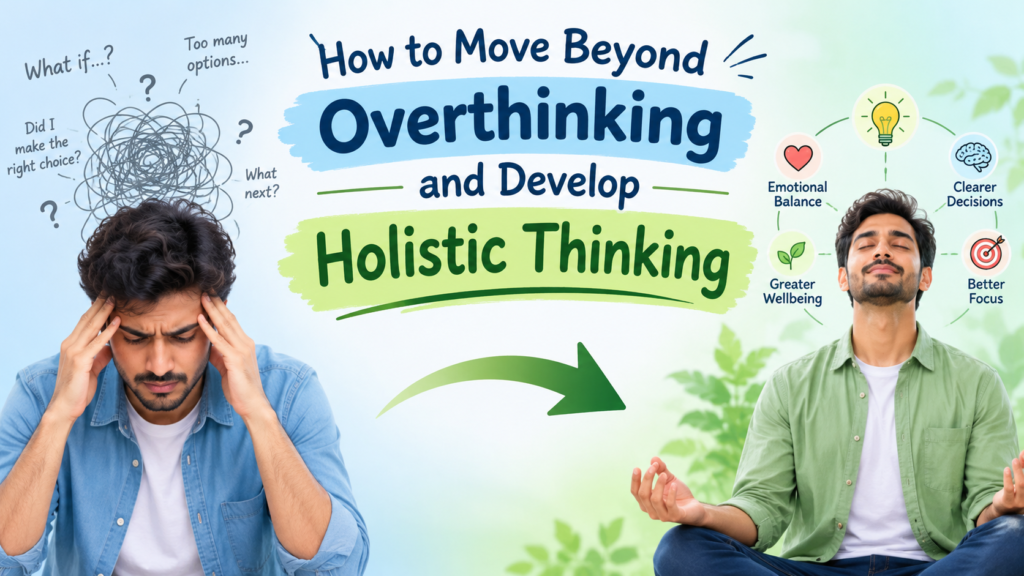
The shift from linear thinking to holistic thinking allows us to see not only individual details but also the relationships, patterns, and possibilities that connect them.
Our minds are naturally drawn towards breaking things down into smaller, manageable parts. This ability helps us organise information, solve problems, and make everyday decisions. However, when we rely exclusively on analysing individual details, we may lose sight of the larger picture.
At Skanda Wellbeing, we believe that understanding how we think is an important part of understanding how we live, respond, and grow.
Let’s explore how holistic thinking can help us approach life’s complexities with greater awareness and flexibility.
1. Linear Thinking vs Holistic Thinking: Understanding the Difference
Linear thinking follows a sequence.
One event leads to another. One problem requires one solution. One action produces an expected result.
For example, imagine that you receive critical feedback at work.
A linear response might be:
- My manager criticised my presentation.
- Therefore, my presentation was unsuccessful.
- Perhaps I am not good at my job.
- I should avoid presenting next time.
Notice how quickly the mind moves from one event to a broader conclusion.
Holistic thinking creates space between the event and the interpretation.
Instead of focusing exclusively on the criticism, you consider the context:
- What specifically did my manager point out?
- Were there aspects of the presentation that worked well?
- Was the feedback about my communication, the content, or the timing?
- What can I learn from this experience?
- How might I approach the next presentation differently?
The situation has not changed. Your perspective has.
Linear thinking is not inherently wrong. Sequential analysis is essential for planning, learning, and solving clearly defined problems. Difficulties arise when we expect a linear approach to resolve situations involving multiple variables, emotions, relationships, and uncertain outcomes.
Holistic thinking complements analytical reasoning by helping us recognise connections that might otherwise remain unnoticed.
The takeaway: You do not need to stop analysing. You need to learn when to step back and see the bigger picture.
Read more about – What Happens in a Sound Healing Session
2. Why Overthinking Can Make Decision-Making More Difficult
Overthinking often begins with a reasonable intention: we want to make the right decision.
We revisit conversations, anticipate reactions, imagine alternative outcomes, and search for certainty.
The difficulty begins when reflection stops producing new understanding and becomes repetitive.
You may find yourself asking the same questions without discovering new information. You may delay taking action because you are waiting to feel completely certain. Or you may become so focused on avoiding mistakes that you overlook opportunities for growth.
This can happen because complex situations rarely offer perfect information.
Consider a person deciding whether to change careers.
An exclusively analytical approach might focus on salary, qualifications, job security, and professional status. These factors matter, but they are not the whole story.
A broader perspective also considers:
- Personal values and long-term aspirations.
- Emotional wellbeing and stress levels.
- Family responsibilities and practical constraints.
- Opportunities for learning and development.
- The kind of life the person wants to build.
This approach does not eliminate uncertainty. Instead, it helps the person make a more informed decision by considering multiple dimensions.
How to interrupt an overthinking loop
When you notice repetitive thinking, pause and ask yourself three questions:
- Am I discovering something new?
If you are repeatedly reviewing the same information, another round of analysis may not be useful.
- What information is actually missing?
Identify the specific question you need to answer rather than trying to solve every possible problem at once.
- What is one constructive action I can take?
You may need to ask someone for clarification, gather additional information, establish a boundary, or make a small decision.
The goal is not to suppress your thoughts. It is to help reflection become more purposeful.
3. Holistic Thinking and the Wisdom of Ancient Indian Traditions
Long before modern psychology developed its contemporary vocabulary, Indian philosophical and contemplative traditions explored the relationship between attention, awareness, perception, and the experience of the whole.
One meaningful connection can be found in the Srimad Bhagavatam, particularly the story of Krishna revealing the universe within his mouth to Mother Yashoda.
In the familiar narrative, Yashoda initially approaches a situation through the ordinary lens of a mother responding to her child’s behaviour. When Krishna opens his mouth, she witnesses a vast cosmic vision that transforms her understanding of what she is seeing.
The story offers a powerful metaphor for perception.
Sometimes, what appears to be the entire reality is only one small part of a much larger picture.
We experience something similar in everyday life.
A colleague’s silence may seem like rejection until we understand the pressure they are experiencing. A setback may appear to be a failure until we recognise what it has taught us. A disagreement may look like a personal attack until we consider the different experiences and expectations involved.
The situation itself may contain more possibilities than our first interpretation allows.
This does not mean dismissing facts or assuming that every difficult experience has a hidden positive meaning. It means recognising that our initial perspective may be incomplete.
From observation to awareness
Indian contemplative traditions offer various practices that encourage attention, reflection, and awareness.
When approached thoughtfully, these practices can complement modern approaches to self-reflection and emotional regulation.
For example, mindful observation encourages us to notice a thought without immediately accepting it as fact.
Instead of saying, “Nobody respects me,” we might recognise, “I am having the thought that I am not being respected because of what happened in that meeting.”
That small distinction creates room to examine the situation rather than reacting automatically.
Ancient wisdom and contemporary psychology are not interchangeable, and their concepts should not be treated as identical. However, both offer useful perspectives on the importance of observing our mental processes rather than being governed by every thought that arises.
The takeaway: A wider perspective begins when we become curious about our interpretation instead of treating it as the only possible truth.
4. Cognitive Flexibility: The Ability to Change Your Perspective
What happens when a situation changes but your response remains the same?
You may continue using a strategy that no longer works. You may hold on to an expectation that reality cannot meet. You may repeat a familiar response even when it creates frustration.
This is where cognitive flexibility becomes valuable.
Cognitive flexibility is the ability to adjust your thinking, consider alternative perspectives, and adapt your approach when circumstances change.
It does not mean abandoning your values or changing your opinion to please others. It means remaining open to new information and being willing to revise an approach when the evidence supports doing so.
Four ways cognitive flexibility can help
-
Better problem-solving
You become more willing to explore different solutions instead of assuming that the first idea is the only option.
-
More thoughtful communication
You can listen to another person’s perspective without immediately preparing a defence.
-
Greater adaptability
You can adjust expectations and plans when circumstances change.
-
More considered emotional responses
You learn to create a pause between an emotional trigger and your next action.
These abilities may support personal development, workplace relationships, and everyday decision-making. They do not guarantee that every situation will become easier, but they can help you respond more deliberately.
A simple exercise: Three perspectives
When facing a difficult situation, write down three possible interpretations.
For instance, if a friend has not responded to your message:
- Interpretation one: They are upset with me.
- Interpretation two: They are busy or distracted.
- Interpretation three: I do not yet have enough information to know why they have not responded.
You do not have to believe all three explanations.
The purpose is to recognise that your first interpretation is not necessarily the only one.
This simple exercise can help you pause before making assumptions or reacting emotionally.
5. The Broken Carpet: A Story About Seeing Beyond Mistakes
Imagine an apprentice working on a beautiful tapestry.
One afternoon, the apprentice accidentally pulls the wrong thread. A dark strand cuts across the delicate pattern of golden silk.
Panicking, the apprentice focuses entirely on the damaged section.
He begins imagining everything that could go wrong. If he removes the thread, he might ruin the design further. If he leaves it, the mistake may remain visible. The more he analyses the problem, the less capable he feels of finding a solution.
The master approaches and studies the tapestry.
Rather than looking only at the damaged thread, he steps back to see the entire design.
He then introduces another dark-blue thread on the opposite side, creating a new pattern that incorporates the unexpected mark.
What began as a mistake becomes part of a different design.
This story illustrates an important principle: sometimes, solving a problem requires changing your relationship with it rather than trying to erase it immediately.
In real life, not every mistake can be transformed into an advantage. Some errors require correction, accountability, or repair.
However, many situations allow us to respond creatively once we stop treating the original plan as the only acceptable outcome.
Applying the lesson to everyday life
Imagine that a project you have worked on for months does not succeed.
You could focus exclusively on what went wrong. Alternatively, you could examine the experience more broadly.
Ask yourself:
- What did this experience reveal about my assumptions?
- Which parts of my approach were effective?
- What would I do differently with the knowledge I now have?
- Is there another way to use the skills or resources I developed?
- What needs to be repaired, and what can be learned?
This approach does not deny disappointment. It allows disappointment and learning to coexist.
The aim is to move from self-criticism towards constructive reflection.
6. The Ego Trap: When Protecting Your Identity Limits Growth
Have you ever found yourself defending a decision even after new information suggested that you might be wrong?
Perhaps you struggled to admit a mistake because you worried about how others would perceive you. Maybe you continued an argument because acknowledging another person’s point felt like losing.
These experiences highlight the relationship between identity, emotions, and decision-making.
When our sense of self becomes closely tied to being right, successful, or in control, changing our position can feel threatening.
We may begin defending our previous choices rather than evaluating whether they remain appropriate.
In the context of the article’s discussion, the concept of ahamkara, often associated with the sense of “I” or self-identification in Indian philosophical traditions, offers a way to reflect on this tendency.
It is important not to treat the ego as something that must simply be eliminated. A stable sense of self can be valuable. The challenge is recognising when the need to protect our identity interferes with learning and adaptation.
How to respond without becoming defensive
The next time someone challenges your opinion, try these three steps.
Pause: Notice your immediate emotional reaction before responding.
Explore: Ask what information or experience has led the other person to their conclusion.
Evaluate: Consider whether their perspective reveals something you had overlooked.
You can disagree respectfully while remaining open to learning.
This is particularly useful in close relationships, workplace conversations, and leadership situations where different perspectives are inevitable.
Remember: Being willing to reconsider an idea is not a sign of weakness. It is an expression of intellectual maturity.
7. How to Develop Holistic Thinking in Daily Life
Holistic thinking is not simply an abstract concept. You can practise it through small, deliberate changes in how you observe situations, process emotions, and make decisions.
Here are five practical ways to begin.
Practice 1: Zoom out before you react
When something upsetting happens, resist the urge to interpret it immediately.
Take a moment to consider the broader circumstances.
Ask yourself:
- What happened objectively?
- What am I assuming about it?
- What context might I be missing?
- What response would be useful rather than merely immediate?
This practice can help you distinguish between an event and the meaning you assign to it.
Practice 2: Connect the dots
When dealing with a recurring problem, examine the relationships between its different parts.
For example, if you regularly feel exhausted, consider more than your workload.
Look at your sleep, daily routines, expectations, boundaries, relationships, and opportunities for rest.
This does not mean that all these factors are necessarily responsible. It means examining the wider context before settling on an explanation.
Practice 3: Build a mindful pause into your day
Spend five minutes observing your breathing, bodily sensations, and thoughts without trying to change them immediately.
When your attention wanders, gently bring it back.
The purpose is not to empty your mind or achieve a particular state. It is to practise noticing what is happening before automatically responding.
If sitting quietly feels uncomfortable, try a mindful walk or a few minutes of gentle attention to your surroundings.
Practice 4: Ask better questions
The quality of your questions can influence the quality of your reflection.
Instead of asking, “Why does this always happen to me?” consider asking:
- What pattern am I noticing?
- What factors may be contributing to this situation?
- What is within my control?
- What is outside my control?
- What is one realistic step I can take?
Better questions can help move your attention from repetitive frustration towards constructive action.
Practice 5: Review your day without judging yourself
At the end of the day, reflect on one situation that challenged you.
Write down:
- What happened?
- How did I interpret it?
- How did I respond?
- What other perspective could I consider?
- What would I like to practise next time?
This exercise encourages self-awareness without requiring you to label every response as good or bad.
Over time, it may help you recognise recurring patterns and identify opportunities to respond differently.
8. A Seven-Day Action Plan to Strengthen Holistic Thinking
Understanding a concept is useful. Practising it is where the learning becomes personal.
Use this seven-day plan to introduce holistic thinking into your routine.
Day 1: Observe your thinking
Notice when you jump to conclusions. Write down one example without criticising yourself.
Day 2: Consider alternative explanations
Choose a situation that frustrated you and identify two other possible interpretations.
Day 3: Identify the bigger picture
Take one ongoing challenge and map its contributing factors, including practical circumstances, emotions, expectations, and relationships where relevant.
Day 4: Practise a mindful pause
Spend five minutes observing your breathing and thoughts. Notice whether a brief pause changes how you approach the next task.
Day 5: Listen to understand
During a conversation, focus on understanding the other person’s perspective before offering your own.
Day 6: Reframe a setback
Identify one mistake or disappointment. Separate what needs to be corrected from what you can learn.
Day 7: Reflect and choose one action
Review the week. Which exercise helped you see a situation differently? Choose one practice to continue.
You do not need to complete every exercise perfectly.
The purpose is to build a habit of stepping back, observing more carefully, and choosing your response with greater awareness.
9. The Benefits of Moving Towards a More Flexible Mindset
Developing a more holistic and flexible approach to thinking may help you:
- Make more considered decisions: Evaluate multiple factors before choosing a course of action.
- Reduce unproductive rumination: Recognise when repeated analysis is no longer helping you move forward.
- Improve relationships: Consider perspectives beyond your immediate emotional response.
- Adapt to change: Explore alternatives when familiar strategies no longer work.
- Strengthen self-awareness: Notice the assumptions and patterns influencing your behaviour.
- Approach setbacks constructively: Distinguish between what requires correction and what can become a learning opportunity.
- Respond more thoughtfully to stress: Create space to evaluate a situation before acting.
These are potential benefits, not guaranteed outcomes. Holistic thinking is one useful skill among many, and it works best alongside practical problem-solving, emotional awareness, healthy boundaries, and appropriate professional support when needed.
10. From Holistic Vision to Meaningful Action
There is an important distinction between seeing the bigger picture and acting on it.
You might understand why a relationship feels strained but still need to have a difficult conversation. You might recognise that your work habits are unsustainable but still need to change your schedule. You might understand your emotional triggers but still need time and practice to respond differently.
Awareness creates an opportunity. Action turns that opportunity into experience.
A useful process is:
Observe → Understand → Reframe → Choose → Act → Reflect
First, observe the situation without rushing to judgement.
Next, understand the factors contributing to it.
Then, consider alternative perspectives and decide what matters most.
Choose one constructive action, implement it, and reflect on the outcome.
If the result is not what you expected, use the information to adjust your approach.
This is not about controlling every outcome. It is about becoming more intentional in how you meet life’s uncertainties.
At Skanda Wellbeing, we see self-awareness as an ongoing journey rather than a destination. Learning to recognise our patterns, understand our responses, and explore new perspectives can help us develop a more thoughtful relationship with ourselves and the world around us.
Final Reflection: What Would Change If You Could See the Bigger Picture?
The mind is remarkably capable of analysing, organising, and solving problems. Yet, some of life’s most meaningful challenges ask us to do more than analyse.
They ask us to listen, observe, question our assumptions, recognise connections, and remain open to possibilities we may not have considered.
Holistic thinking does not require abandoning logic. It invites us to use logic alongside context, awareness, and adaptability.
You may not be able to change every situation you encounter. But you can learn to examine your perspective, recognise your options, and choose your next step more deliberately.
Your reflection for today:
Think of one situation that has been occupying your mind.
What might you notice if you stepped back from the individual details and looked at the bigger picture?
Give yourself a moment to explore the question. You may not find an immediate answer, and that is perfectly fine.
Sometimes, a new way of seeing is the beginning of a new way forward.
Continue Your Journey with Skanda Wellbeing
At Skanda Wellbeing, we explore the connection between modern psychology, ancient wisdom, emotional awareness, and conscious living.
If you are interested in understanding your thought patterns, exploring emotional wellbeing, or developing a more mindful approach to everyday life, discover our resources and services.
Visit skandawellbeing to learn more.
Heal Within. Live Better.