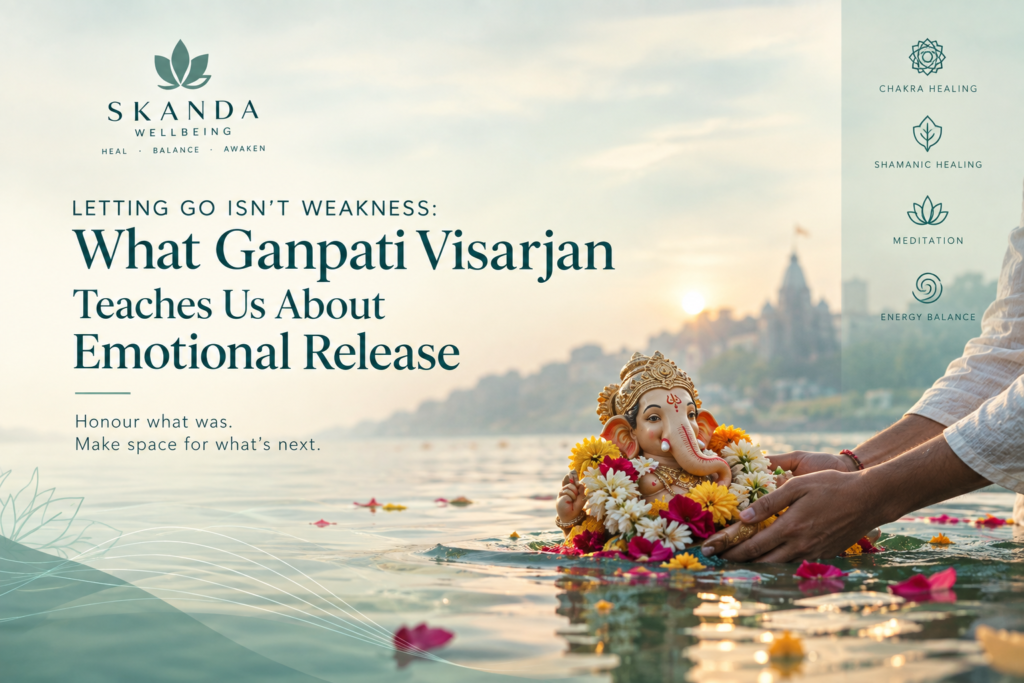
There is something profoundly beautiful about Ganpati Visarjan.
For days, we welcome Ganesha into our homes.
We decorate.
We pray.
We celebrate.
We create memories.
And then comes the moment when we have to say goodbye.
Ganpati Visarjan.
The very thing we welcomed with love must eventually be released.
For many people, that moment carries an unexpected emotional weight.
Why?
Because letting go is rarely just about losing something.
It is about accepting that something meaningful can have a beginning, a beautiful presence—and an ending.
And perhaps that is one of the most powerful lessons Ganpati Visarjan offers us.
Letting go is not weakness.
Sometimes, it is an act of trust.
Why Do We Find Letting Go So Difficult?
Humans naturally form attachments.
To people.
Places.
Memories.
Roles.
Dreams.
Relationships.
Versions of ourselves.
Sometimes we hold on because something still matters.
But sometimes we hold on because we are afraid of what happens when we release it.
What if I regret it?
What if I lose part of myself?
What if nothing better comes?
What if letting go means admitting that it is over?
These questions can keep emotional experiences alive long after the situation itself has changed.
You will be also like to read about :- What does nervous system regulation actually mean
Emotional Release Is Not “Forgetting”
This distinction matters.
Letting go does not mean pretending something never happened.
It doesn’t mean saying:
“It didn’t matter.”
It means being able to say:
“It mattered. And I don’t need to carry it in the same way anymore.”
You can honour a relationship without remaining attached to it.
You can honour grief without living permanently inside it.
You can honour a chapter without refusing to turn the page.
The Wisdom of Ganpati Visarjan
Ganpati Visarjan symbolically brings together two seemingly opposite experiences:
Love and release.
You can love deeply and still let go.
You can be grateful and still move forward.
You can miss something and still choose the future.
That is emotional maturity.
And perhaps this is why rituals of closure can feel so powerful.
They give the heart a language for something the mind struggles to explain.
Where Does Emotional Release Happen?
Emotional release isn’t simply “getting emotions out.”
Healthy emotional processing involves recognising what you feel, understanding it, allowing space for it and developing a safe way of responding.
You might notice emotional experiences through:
- Tightness in the chest
- A clenched jaw
- Tears
- Restlessness
- Fatigue
- A heavy feeling
- Difficulty sleeping
- Irritability
- Feeling emotionally numb
These sensations do not automatically prove that an emotion is “stored” in a particular body part.
But they can become useful signals inviting you to slow down and pay attention.
Chakra Healing: A Different Language for Inner Experience
Chakra traditions offer an energetic framework for understanding balance, emotional experience and spiritual wellbeing.
At Skanda Wellbeing, Chakra Healing & Meditation works with the traditional seven main energy centres through practices such as meditation, visualisation, breathwork, sound and colour-based approaches.
For someone drawn to this framework, chakra work can provide a reflective language for questions such as:
Where am I holding back?
Where do I feel disconnected?
What am I afraid to express?
What am I ready to release?
It can become less about “fixing a blocked chakra” and more about creating space for self-awareness.
What About Shamanic Healing?
Shamanic healing comes from diverse traditional practices and should not be reduced to one universal technique.
At Skanda, Shamanic Healing is presented as an earth-based, intention-led practice focused on energetic cleansing, grounding, spiritual awareness and alignment.
For people who resonate with spiritual approaches, the experience can become a meaningful ritual of reflection and transition.
The important part is intention.
What are you ready to release?
Not because someone told you that you should.
But because you have recognised that carrying it forward is no longer serving you.
Try This Visarjan-Inspired Reflection
You don’t need to wait for a festival to practise conscious release.
Take a quiet moment and complete these sentences:
I am grateful for…
I am ready to forgive…
I am ready to stop carrying…
I learned…
I no longer need to prove…
I give myself permission to leave behind…
I am making space for…
Don’t rush to produce beautiful answers.
Let the answers surprise you.
Letting Go Can Be Grief
Sometimes we romanticise letting go.
But release can hurt.
You may grieve the person you thought someone would become.
The relationship you hoped would work.
The career you imagined.
The version of yourself you outgrew.
The future you planned.
That grief doesn’t mean you are making the wrong decision.
Sometimes grief is simply the heart acknowledging change.
You Don’t Have to Release Everything at Once
Healing isn’t a dramatic emotional purge.
Sometimes letting go happens in layers.
One day you stop checking.
Another day you stop explaining.
Eventually, you remember without reliving.
You can talk about it without becoming overwhelmed.
You can think about it without wanting to go back.
That is release.
Quiet.
Gradual.
Real.
A New Way to Think About Ganpati Visarjan
Perhaps the deeper message is not:
“Everything we love must disappear.”
Perhaps it is:
“Everything changes, and love can exist without possession.”
The idol returns to the elements.
The celebration becomes memory.
The season moves forward.
And we do too.
At Skanda Wellbeing, Chakra Healing and Shamanic Healing offer pathways for those who wish to explore emotional and energetic wellbeing through an integrative, spiritually informed approach.
If you are carrying something you are ready to understand, process or release, you don’t have to rush the journey.
Sometimes the first step is simply acknowledging:
“I am ready to put this down.”
Book a Chakra Healing or Shamanic Healing session with Skanda Wellbeing.