How unprocessed emotions affect your emotional healing, subconscious mind, and stress management
Have you ever said “I’m fine” when you were clearly not fine?
Most people have.
In today’s high-pressure world, emotional suppression is often mistaken for strength, professionalism, maturity, or resilience. We learn to keep moving, stay productive, avoid conflict, and push our feelings aside so we can function.
But emotions that are ignored rarely disappear.
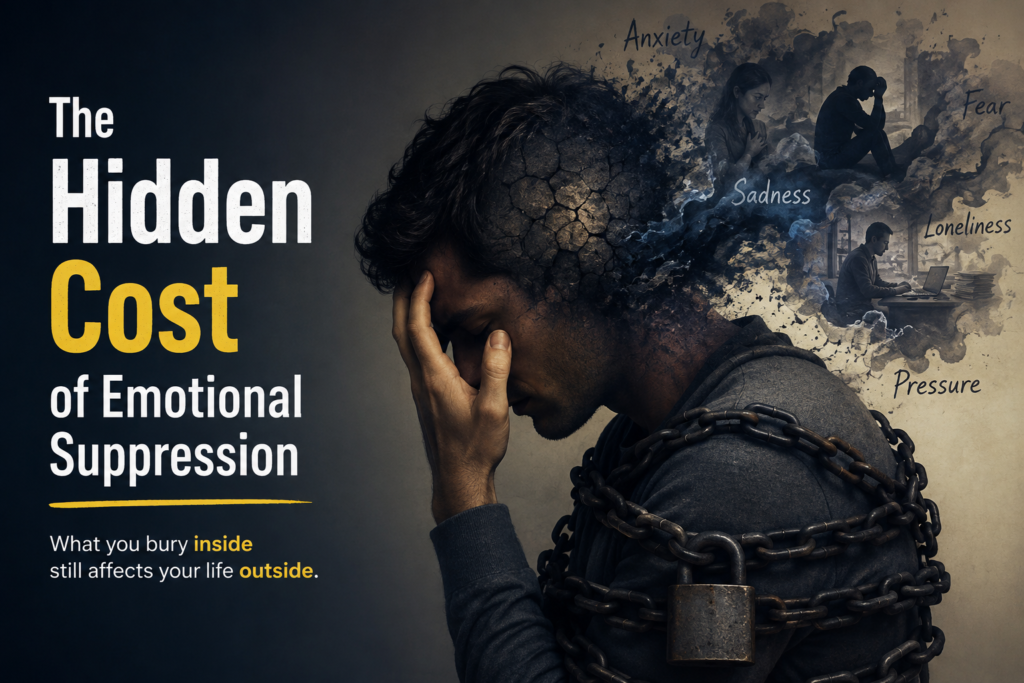
They often move inward—into the subconscious mind, the nervous system, and eventually the body itself.
At Skanda Wellbeing, one of the most common patterns we observe is not a lack of emotion, but a lifetime of unexpressed emotion. Understanding the hidden cost of emotional suppression is an important step toward emotional healing, inner balance, and long-term stress management.
What Is Emotional Suppression?
Emotional suppression occurs when we consciously or unconsciously block, avoid, minimize, or hide our feelings.
This may include suppressing:
- Anger
- Sadness
- Fear
- Grief
- Hurt
- Disappointment
- Shame
- Loneliness
- Frustration
- Emotional needs
Many people suppress emotions because they were taught that expressing them was unsafe, inconvenient, or unacceptable.
Common beliefs include:
- “Don’t cry.”
- “Stay strong.”
- “Others have it worse.”
- “Keep the peace.”
- “Be professional.”
- “You’re too sensitive.”
Over time, suppression can become automatic.
The Subconscious Mind Never Stops Recording
One of the most overlooked aspects of emotional wellness is the role of the subconscious mind.
Even when the conscious mind tries to ignore an emotion, the subconscious continues to store the emotional experience, associated memories, body sensations, and survival responses.
Think of it like closing an app on your screen while it continues running in the background.
You may not be actively thinking about the hurt, rejection, criticism, betrayal, or unresolved conflict—but your nervous system may still be responding to it.
This is why emotional suppression can lead to:
- Chronic stress
- Anxiety
- Emotional reactivity
- Overthinking
- Fatigue
- Relationship conflicts
- Sleep disturbances
- Physical tension
- Burnout
Why Suppressed Emotions Become Stress
Emotions are designed to move through us, not remain trapped within us.
When emotions are repeatedly suppressed, the body often stays in a subtle state of fight, flight, freeze, or fawn response.
The stress management problem is not always the external situation—it is the constant internal effort required to hold emotions down.
This ongoing effort can increase:
- Cortisol levels
- Muscle tension
- Mental exhaustion
- Irritability
- Emotional numbness
- Difficulty concentrating
- Feelings of disconnection from yourself
Many people experiencing burnout recovery challenges are actually dealing with years of emotional suppression combined with chronic stress.
7 Hidden Signs You May Be Suppressing Emotions
1. You Stay Busy All the Time
Constant productivity may be serving as a distraction from uncomfortable feelings.
2. You Struggle to Identify What You Feel
When asked how you are feeling, you respond with “stressed,” “tired,” or “fine” because deeper emotions feel unclear.
3. Small Things Trigger Big Reactions
Suppressed emotions often accumulate until a minor event releases a disproportionate emotional response.
4. You Avoid Difficult Conversations
Fear of conflict can lead to silence, resentment, and emotional disconnection.
5. You Feel Emotionally Numb
Not feeling sadness does not always mean you are healed. Sometimes it means you have learned not to feel much of anything.
6. Your Body Holds Constant Tension
Tight shoulders, jaw clenching, headaches, digestive discomfort, and chronic fatigue can be connected to unprocessed stress.
7. You Feel Drained Around Certain People
Emotional suppression often requires significant energy, especially in relationships where you cannot express your authentic feelings.
The Connection Between Emotional Suppression and Relationships
One of the most significant hidden costs is the impact on relationships.
When emotions are not expressed healthily, they tend to appear indirectly through:
- Passive-aggressive behavior
- Withdrawal
- Defensiveness
- Irritability
- Emotional shutdown
- People-pleasing
- Difficulty trusting others
- Fear of vulnerability
Healthy relationships require emotional awareness, honest communication, and emotional regulation. Suppression often creates distance where connection is needed most.
Emotional Healing Is Not Emotional Dumping
A common misconception is that emotional healing means expressing every feeling immediately and intensely.
True emotional healing is not about uncontrolled emotional release. It is about:
- Recognizing what you feel
- Understanding why you feel it
- Allowing the emotion to be acknowledged
- Processing it safely and compassionately
- Responding consciously rather than reacting impulsively
Healing involves awareness, regulation, reflection, and integration.
How the Body Speaks When Emotions Stay Silent
Research in mind-body wellness, trauma-informed healing, and emotional health increasingly supports the connection between emotional stress and physical symptoms.
Unprocessed emotions may contribute to:
- Chronic fatigue
- Sleep disturbances
- Digestive issues
- Muscle pain
- Headaches
- Restlessness
- Shallow breathing
- Increased sensitivity to stress
This does not mean every physical symptom is caused by emotions, but emotional wellbeing can significantly influence overall health, resilience, and recovery.
A Simple Practice for Emotional Awareness
Try this gentle daily check-in:
Step 1: Pause for One Minute
Sit comfortably and take three slow breaths.
Step 2: Ask Yourself
- What am I feeling right now?
- Where do I feel it in my body?
- What might this feeling be trying to tell me?
Step 3: Name the Emotion
Instead of saying “I’m stressed,” try identifying whether you feel:
- Hurt
- Overwhelmed
- Lonely
- Angry
- Disappointed
- Anxious
- Unappreciated
- Afraid
- Grieving
Naming an emotion helps the brain move from reactivity toward regulation.
Healthy Alternatives to Emotional Suppression
Supportive emotional wellness practices may include:
- Journaling
- Breathwork
- Mindfulness meditation
- Sound healing
- Gentle movement or yoga
- Reflective conversation
- Creative expression
- Guided relaxation
- Therapeutic emotional processing
- Compassionate self-observation
The goal is not to become emotionally perfect. The goal is to become emotionally connected to yourself.
Why Emotional Healing Improves Stress Management
Effective stress management is not just about reducing external demands. It is also about reducing the internal pressure created by unprocessed emotions.
When emotions are acknowledged and processed:
- The nervous system feels safer
- Mental clarity improves
- Emotional reactivity decreases
- Sleep often becomes more restorative
- Relationships become more authentic
- Energy is no longer consumed by constant emotional suppression
This is why emotional healing is a foundational part of holistic wellbeing.
The Quiet Transformation
Emotional suppression often develops gradually, and so does healing.
You may notice subtle changes first:
- Feeling calmer during conflict
- Recovering more quickly from stress
- Sleeping with fewer racing thoughts
- Saying “no” without overwhelming guilt
- Feeling more connected to your body
- Experiencing moments of genuine peace
These small shifts are often signs that the subconscious mind is no longer carrying the entire burden alone.
Final Thoughts
The hidden cost of emotional suppression is rarely visible from the outside.
A person may appear successful, responsible, calm, and capable while silently carrying years of unprocessed stress, grief, disappointment, fear, or emotional exhaustion.
Real strength is not the absence of emotion.
Real strength is the ability to acknowledge your inner experience with honesty, compassion, and awareness.
If you have been feeling constantly tense, emotionally drained, disconnected from yourself, or exhausted despite trying to stay strong, it may be worth exploring whether your body is asking for emotional healing rather than more emotional suppression.
Sometimes the most powerful form of stress management is not learning how to ignore your feelings better—it is learning how to listen to them safely and gently.
Explore More from Skanda Wellbeing
At Skanda Wellbeing, we share insights on emotional healing, subconscious mind awareness, stress management, nervous system healing, meditation, sound healing, hypnotherapy, and holistic wellbeing practices that support a calmer mind, a balanced body, and a more connected life.